
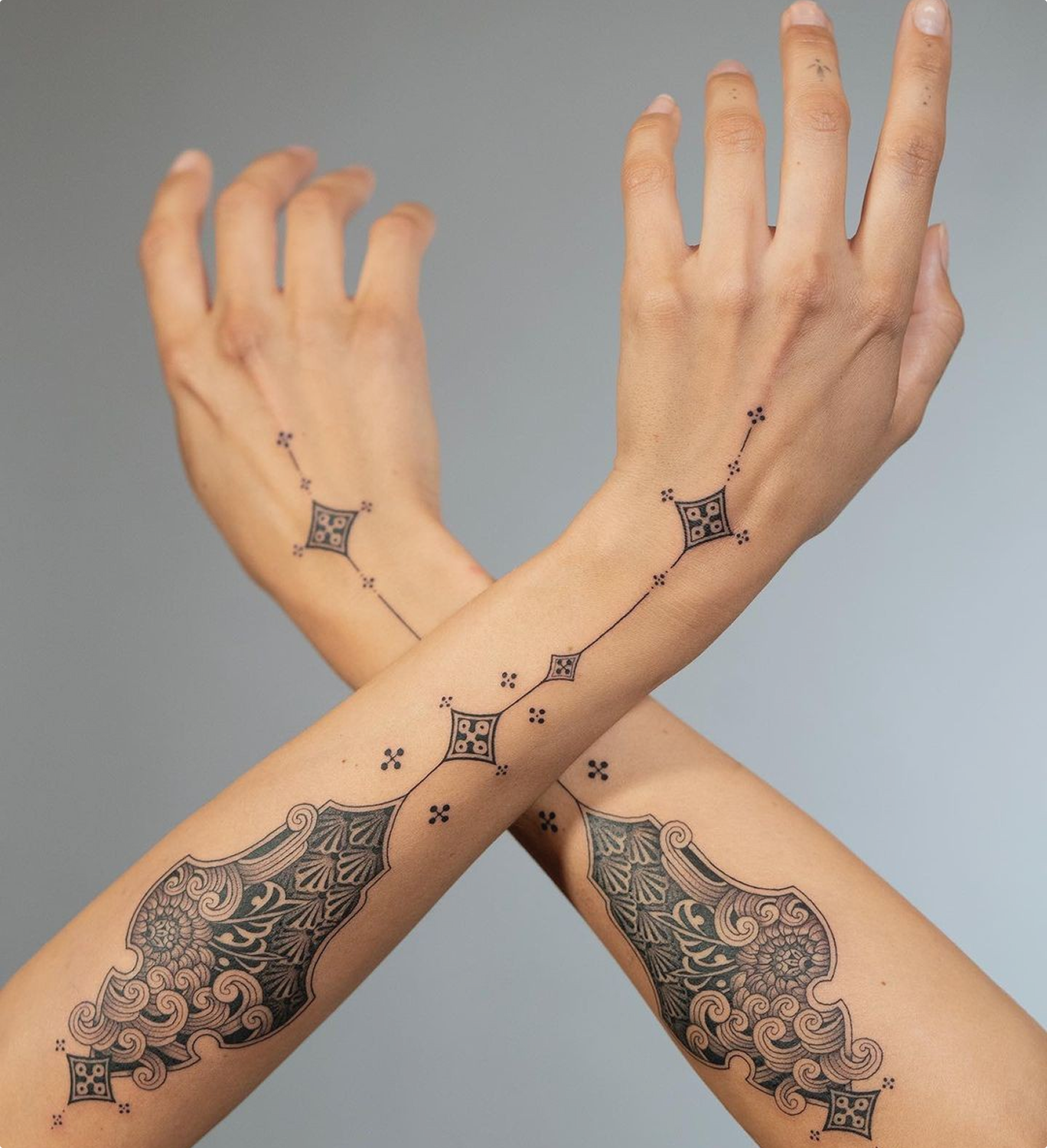
Tattooing has always existed between two impulses: ornament and meaning.
For some people, a tattoo enhances the body aesthetically; a design chosen for beauty, symmetry, or personal symbolism. For others, the tattoo functions as a permanent statement, an idea carried on the body over time.
The difference between decorative tattooing and conceptual tattoo art is not about skill or quality. Both demand technical mastery. The distinction lies in intention.
In Roy’s contemporary practice, tattooing operates as conceptual art where the body becomes not only surface, but site.
Decorative tattooing prioritizes visual composition. Placement, symmetry, line quality, shading, and stylistic coherence guide the design process. A successful decorative tattoo flows naturally with the anatomy and enhances the body’s appearance. Many tattoo traditions focus on craftsmanship and ornamental beauty. From traditional tattoo styles to modern illustrative work, decorative tattooing celebrates the visual relationship between image and body.Meaning may still exist within the design, but the primary objective is aesthetic harmony. The tattoo looks balanced, deliberate, and visually satisfying.
Conceptual tattoo art begins with a different question. Instead of asking “How will this look?”, the process begins with “What does this permanently assert?”
In Roy’s work, each tattoo composition emerges from inquiry: narrative context, psychological weight, permanence, and the relationship between body and concept.
Placement is not chosen simply for visual flow. It is determined by meaning.
The body becomes an active participant in the artwork.
Rather than decorating skin, conceptual tattoo art treats the body as part of the structure of the work itself.
Tattooing differs fundamentally from other visual art forms because permanence cannot be separated from the medium.
A painting can be removed from a wall.
A sculpture can be relocated or reinstalled.
A tattoo remains with the body.
For this reason, conceptual tattoo art approaches permanence as responsibility rather than decoration.
In Roy’s practice, tattoo compositions follow the same structural rigor used in painting and sculptural work. Ideas are developed before designs are drawn, and composition is constructed before execution. The result is not simply an image applied to skin. It is a permanent alignment between body and concept.
The phrase “fine art tattoo” has become increasingly common in contemporary tattoo culture. However, it often refers to stylistic refinement rather than conceptual intention.
Roy’s cross-medium practice positions tattoo alongside painting and sculpture within contemporary fine art discourse.
Across all mediums, the same questions persist:
How does permanence affect meaning?
How does the body carry structure?
How do images interact with lived experience?
In this sense, tattoo becomes another artistic surface — one that cannot be removed from the life that carries it.
Clients interested in conceptual tattoo art should expect a slower and more deliberate process.
Roy works selectively on commissioned tattoo projects, applying the same conceptual and technical rigor found in the studio’s painting and sculptural work.
The result is not simply a tattoo. It is a permanent articulation.